Fresnel Integrals
What are Fresnel Integrals?
Fresnel integrals are two functions defined by the following integrals:
While these are the most common definitions, another set of definitions involving a constant factor is also used:
Graphs of
First, let’s examine the behavior of the integrands
Both are even functions and appear smooth near zero, but their oscillations become more intense (i.e., their periods shorten) as they approach the ends.
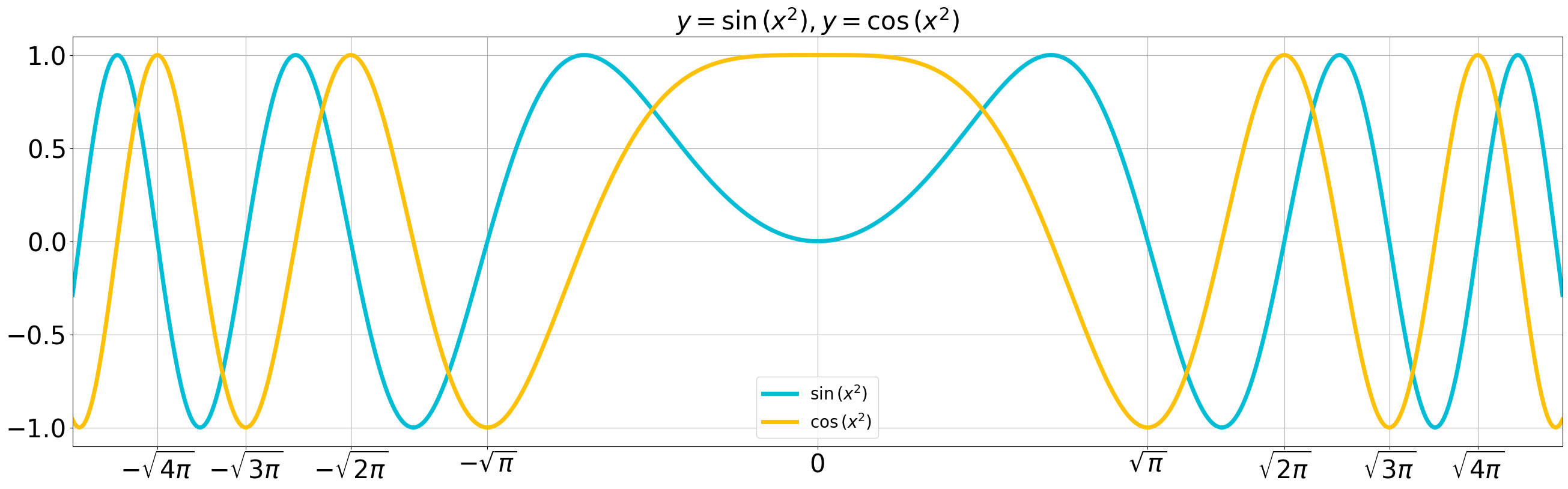
Graphs of
Next, let’s visualize the Fresnel integrals
Both are odd functions and are bounded.
They oscillate at both ends, but the amplitude of these oscillations decreases gradually, suggesting that they converge as
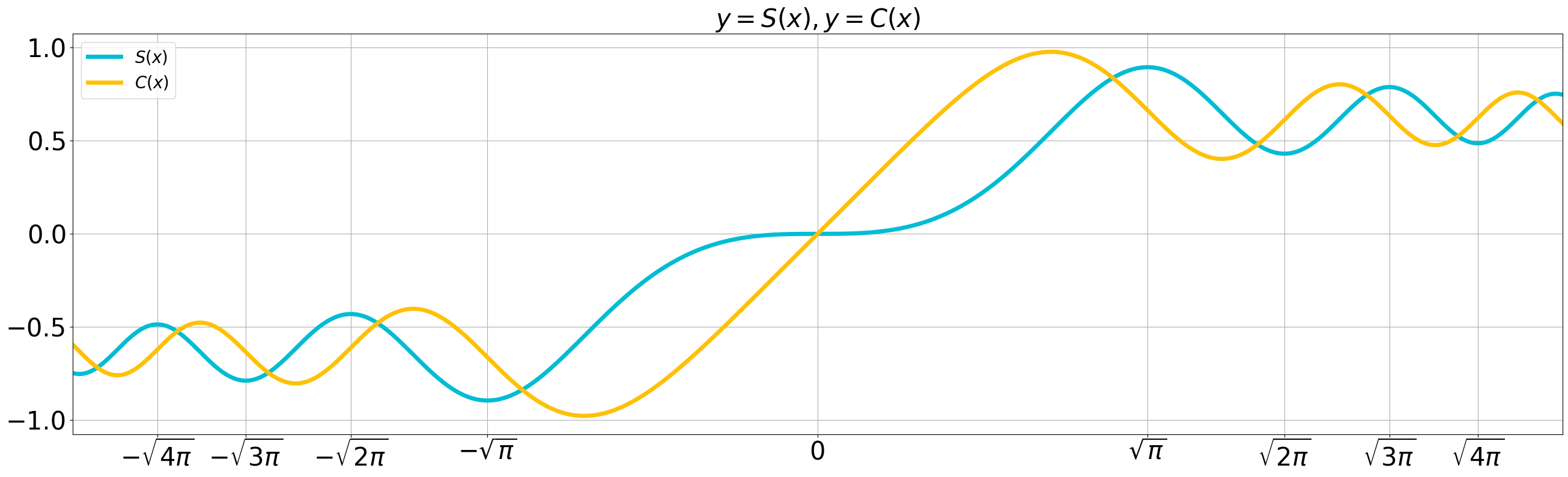
Graphs of
Let’s also consider the trajectory when
As
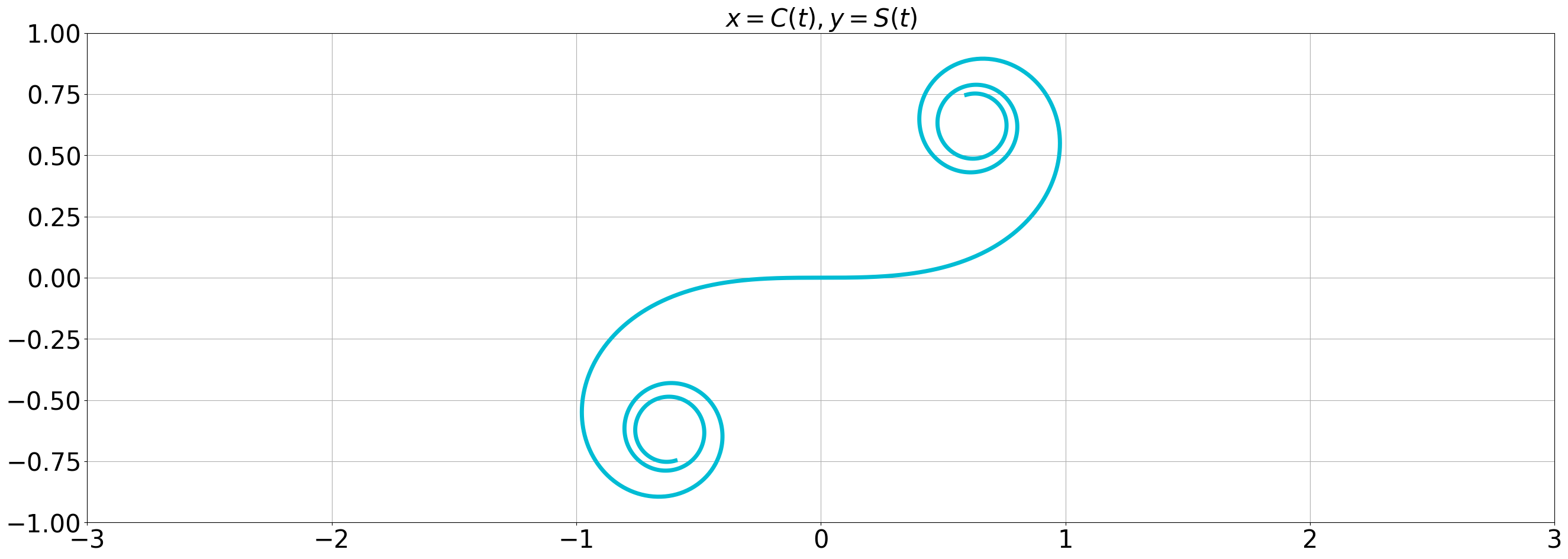
This trajectory is called the Euler spiral, also known as the clothoid or Cornu spiral.
The name “clothoid” was given by Cesàro in honor of the Greek goddess Clotho, who is symbolized by a spool.
Fresnel Integrals in SciPy
The above graphs were created using the scipy.special.fresnel function from the SciPy library.
This function implements the second set of definitions mentioned earlier.
https://docs.scipy.org/doc/scipy/reference/generated/scipy.special.fresnel.html
The graphs above were generated with some suitable transformations.
Limits of Fresnel Integrals
As suggested by the graphs, Fresnel integrals converge as
Consider
Instead of evaluating these integrals individually, consider:
Textbook Solution
Let

Here,
We denote the complex integrals along each path as
Since
Let’s calculate
On the interval of integration,
Thus,
The right-hand side converges to
Therefore,
Next,
Since the right-hand side is a Gaussian integral, as
In summary,
Thus,
Comparing the real and imaginary parts,
This value is approximately 0.626657.
Reviewing the Euler spiral graph, it indeed appears to converge to this value.
Method via Variable Transformation
The method described above is common in textbooks, but the integration path might seem somewhat abrupt.
Let’s look a bit more into why such integration paths are used.
Consider the integral we want to evaluate:
This is very similar to the known Gaussian integral:
Thus, it seems possible to reduce the integral to a Gaussian integral through a variable transformation.
Let’s transform the integral as follows:
Next, consider the variable transformation
This results in a generalized integral along a path in the complex plane that goes towards the lower right.
To evaluate this, consider using a similar approach with a sectorial path in the complex plane.
It becomes evident that the integral effectively behaves like a Gaussian integral on the real axis.
Thus:
This result shows how the path of integration with an eighth-turn appears.
Arc Length of the Euler Spiral
Euler Spiral
has a velocity vector given by
Since its magnitude is 1, the Euler Spiral can be considered to progress by 1 unit per unit time.
Therefore, the arc length of the Euler Spiral from time
である。
Curvature of the Euler Spiral
Additionally, the acceleration vector is
Thus, the radius of curvature is
The curvature is
Additional Notes
The limit of Fresnel integrals was derived using a somewhat technical method. The key was to create an integration path with an eighth-turn to anticipate the Gaussian integral. Another approach involves using the Mellin transform.
The Euler spiral has an interesting property where the arc length and curvature are proportional. This property is utilized in engineering. Specifically, when transitioning from a straight path to a curve with a certain curvature, an abrupt connection to the curve can result in an uncomfortable rate of change in curvature. In terms of driving a car, this means you would need to make sharp turns. Therefore, methods that gradually increase curvature using Euler spirals are considered. (i.e., you gradually steer the wheel). Such “transition” curves are called transition curves or spiral easements.